
Anxiety vs. Insomnia: Which One Is Really Keeping You Awake?
It is the middle of the night.
You are staring at the ceiling, feeling the familiar weight of exhaustion, yet your mind feels strangely alert.
You might be replaying a conversation from yesterday, worrying about a project due tomorrow, or perhaps you are just feeling a generalized sense of unease. In these moments, it is common to wonder: Am I struggling with anxiety, or is this just insomnia?
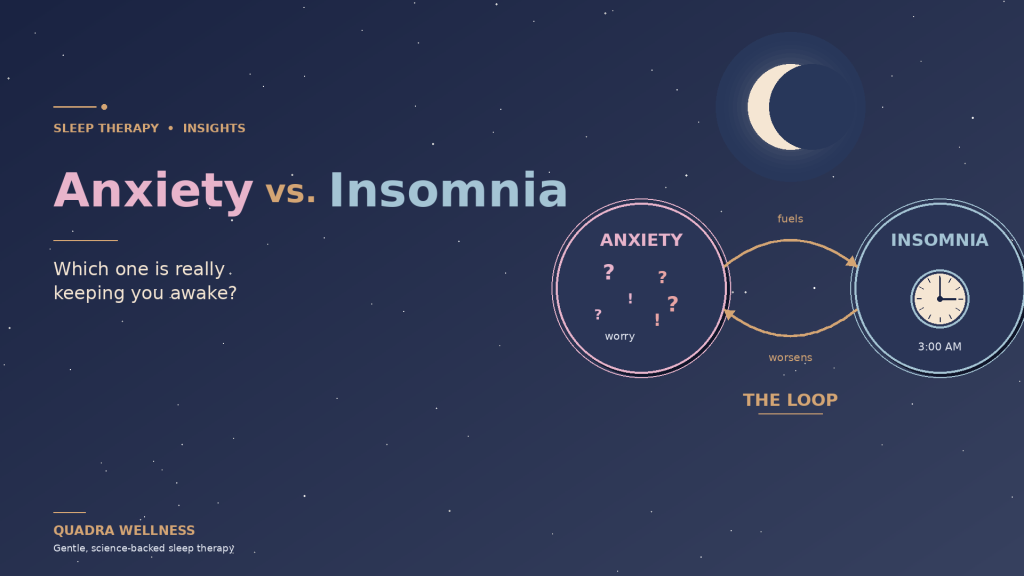
If you have found yourself asking this question, please know that you are not alone. Many people who come to my practice at Quadra Wellness and Counselling feel trapped in a feedback loop where anxiety and sleep challenges seem to blur into one overwhelming experience. It can feel like a “chicken or the egg” scenario, does the anxiety cause the sleeplessness, or does the sleeplessness trigger the anxiety?
The truth is, they are often two sides of the same coin. In sleep therapy, we don’t necessarily need to label them as separate entities to find relief. Instead, we can use techniques from Acceptance and Commitment Therapy (ACT) to change how we relate to both. By learning to “defuse” from the thoughts that keep us awake, we can stop trying to fight our way to sleep and start creating the conditions where rest can arrive on its own.
The Intersection of Anxiety and Sleep
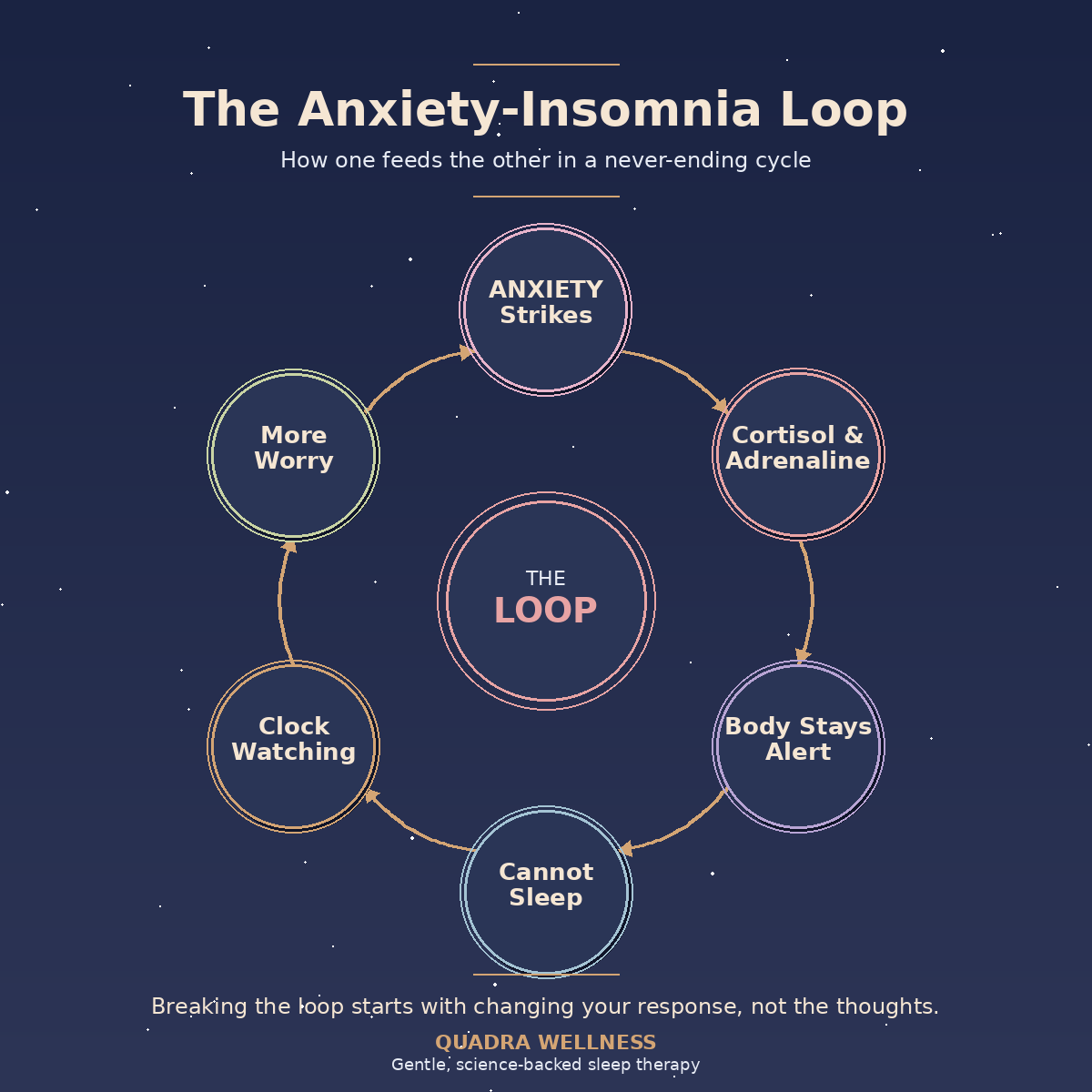
To understand why these two states are so closely linked, we have to look at the brain’s “alarm system.” When you experience anxiety, your body releases hormones like adrenaline and cortisol. These are designed to keep you alert in the face of perceived danger.
From an evolutionary standpoint, this is a brilliant mechanism. However, when we are trying to sleep, this same mechanism works against us. Insomnia, in this context, often acts as a physical manifestation of this heightened state of arousal. Even if you aren’t “thinking” about a specific worry, your nervous system remains in a high-alert mode, making it physiologically difficult for the brain to transition into the stages of sleep.
Many people try to solve this by searching for a single “method”,like a specific breathing exercise or a supplement. But when you are struggling with chronic sleep challenges, a single method can feel like a band-aid on a much larger issue. This is where the ACT-based approach becomes a game-changer.
Rather than trying to force your mind to go quiet, ACT helps you change your relationship with the thoughts that are keeping you awake.
Perspectives from the Practice
In my work as a therapist, I recall a client named Elena. Elena spent hours every night “problem-solving” her life. She would lay in bed and dissect every interaction she’d had during the day, convinced that if she could just find the “correct” solution to her worries, she would finally feel at peace and be able to sleep.
Elena was trapped in a cycle of cognitive fusion, meaning she believed that her thoughts were absolute facts that required immediate attention. When she came to my practice, she was exhausted, not just from the lack of sleep, but from the constant mental work she was performing at 3:00 AM.
Through our sessions, we worked on cognitive defusion. Instead of trying to argue with her anxious thoughts or force them out of her head, she practiced noticing them. She started saying to herself, “I am having the thought that I didn’t do enough today.” By adding that simple phrase, “I am having the thought” she created a tiny bit of space between herself and her worry. She stopped being in the thought and started being an observer of the thought. That small shift was the beginning of her path toward more restful nights.
The Myth of the “Perfect Sleeper”
A major contributor to the anxiety-insomnia loop is the collection of myths we hold about what “normal” sleep looks like. We are often told that we must sleep for eight uninterrupted hours, that we should never wake up during the night, and that any deviation from this is a sign of a “broken” system.
When we hold these rigid expectations, any wakefulness at 2:00 AM becomes a crisis. We start monitoring the clock, calculating how many hours of sleep we have left, and becoming anxious about the consequences of being tired tomorrow. This “sleep perfectionism” is a direct fuel for nighttime anxiety. The reality is that human sleep is often fragmented, and waking up briefly is a normal part of the human experience. By letting go of the demand for perfection, we lower the stakes of the night, which ironically makes it easier to drift back into sleep.
The Role of Hyperarousal: When Your Body Stays “On”
For many clients, the issue isn’t just a busy mind; it’s a body that has forgotten how to power down. This is called hyperarousal. Imagine your nervous system is a car engine that has been idling at high RPMs all day. When you stop the car to park for the night, the engine is still revving loudly.
Hyperarousal is often the result of chronic stress. Even when the stressor is removed, the physiological state persists. This is why “relaxing” doesn’t always work, the body is physically stuck in a state of high alarm. Understanding this helps us move away from self-blame. You aren’t “bad” at sleeping; your nervous system is simply over-active. Our goal, therefore, is not to force the engine to turn off, but to gently guide the nervous system toward safety through gradual, compassionate practices.
Common Factors That Bridge Anxiety and Insomnia
If you feel like your sleep is constantly hijacked by your mind, you are likely navigating one or more of these common contributors:
The “Productivity” Mindset
Many of us feel that if we are awake, we should be “doing” something, even if that something is just worrying or planning. This turns the bed into a workspace for our anxieties.
The “Safety” Search
We often look for external solutions (the “perfect” temperature, the right pillow, the “best” tea) to provide the safety we aren’t finding internally. When these don’t work, we feel less safe, which increases our anxiety.
Hyperarousal
Chronic sleep difficulty can leave your nervous system in a state of constant, low-level vigilance, meaning you are more likely to notice noises, thoughts, or physical sensations that would otherwise be ignored.
Judgment of Wakefulness
The belief that “I must be asleep by now” creates a secondary layer of anxiety, the anxiety about being anxious.
Anxiety vs Insomnia
| Feature | Anxiety-Driven Wakefulness | Insomnia-Driven Wakefulness | The ACT-Based Response |
|---|---|---|---|
| Primary Focus | Future-oriented (worrying/planning). | Performance-oriented (trying to force sleep). | Present-oriented: “What am I experiencing right now?” |
| Brain State | High-level analytical (problem-solving). | High-level monitoring (checking the clock/app). | Observational: “I am having the thought that…” |
| Common Reaction | Trying to “fix” the source of the worry. | Trying to “fix” the lack of sleep. | Acceptance: Dropping the fight to regulate the nervous system. |
| Body State | Sympathetic surge (adrenaline/cortisol). | Physical tension/hyperarousal. | Compassionate Presence: Responding with kindness, not frustration. |
| Goal | To eliminate the source of anxiety. | To eliminate the state of wakefulness. | Valued Living: Existing peacefully alongside the thoughts. |
5 Evidence-Based Strategies to Reclaim Your Rest
Instead of looking for a magic bullet, try these strategies that focus on how you relate to your thoughts and your environment.
1. Practice Cognitive Defusion
When an anxious thought arises, like “I’m never going to get enough sleep”, try to externalize it. Instead of saying, “I have to sleep,” say, “My mind is telling me that I need to sleep.” This practice of defusion helps you realize that your thoughts are just mental events, not orders you have to follow or facts you have to accept.
2. Prioritize “Acceptance of Wakefulness”
This is a core component of both CBT-I and ACT. If you are awake, trying to force yourself back to sleep often backfires by increasing your heart rate and frustration. Acknowledge your state: “I am awake, and that is okay.” Acceptance is not resignation; it is simply dropping the fight so that your nervous system can begin to regulate.
3. Build a “Buffer Zone”
Your bedroom should not be a place for solving your life’s problems. Create a “buffer zone”, a 30 to 60-minute window before bed where you disconnect from high-engagement tasks. This is a time to read, do light stretches, or engage in low-arousal activities that signal to your body that the day is finished.
4. Utilize Stimulus Control
If you find yourself lying in bed for more than 20 minutes feeling restless or anxious, get out of bed. Your brain is likely forming an association between the bed and the anxiety. Go to another room, read a book in dim light, and only return when you feel the physical signs of sleepiness. This is not a “trick”; it is a way to retrain your brain to see the bed as a place for rest.
5. Cultivate Compassion for Your Tiredness
When you are tired, the temptation is to judge yourself, get frustrated, or push harder. Practice treating yourself as you would a dear friend. If a friend told you they were exhausted and struggling, you wouldn’t tell them to “try harder” or “fix it immediately.” You would offer kindness and patience. Directing that same compassion toward yourself at 3:00 AM is one of the most effective ways to lower your internal arousal.
Gradual Improvement is Possible
I want to emphasize that you do not need to be perfect to see improvements. In fact, the “perfectionist” approach to sleep is often what keeps the cycle going. Gradual improvement comes from the small, daily choices to be kind to yourself when your mind gets loud.
You have the capacity to learn how to exist alongside your anxiety without letting it dictate the quality of your nights. It is not about eliminating the thoughts; it is about changing your relationship with them until they no longer have the power to keep you awake.
Every night is an opportunity to practice a new way of being. Even on the nights that feel restless, you are building the skills for a more peaceful future. Take it one night at a time, and remember that restful sleep is an outcome of how you live your days and how you treat your moments of wakefulness.
Ready to transform your relationship with sleep? Learn more about our “Gently to Sleep” program and take the first step toward restful nights and energized days. Contact us to schedule a free sleep consultation.